
Engage and inspire your youth with these free, ready-to use materials for teaching History, Leadership, Ethics and Jewish Values through the life lessons of Jews who fought back during the Holocaust. Designed for 6th-12th grade History, English, Social Studies, Holocaust/Genocide and Jewish Studies classrooms and informal settings (youth groups, summer camps, etc.). Most materials can be completed in 45-60 minutes.
Lesson Plans & Activities: Interactive, thought-provoking lessons and experiential programs - include step-by-step procedures, teacher guides, and illustrations.
Study Guides & Biographies: Profiles and articles with critical thinking questions stimulate discussion on a variety of topics from living and surviving to women in the partisans.
Featured Curricula
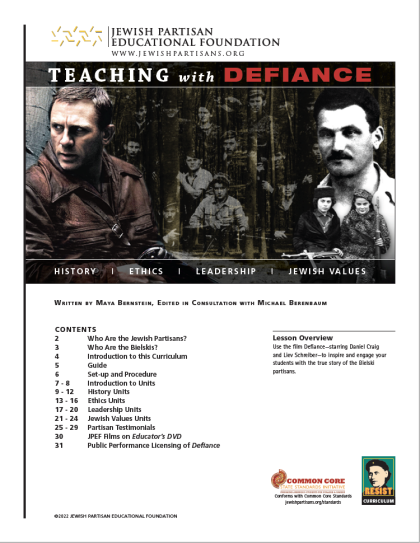
Teaching with "Defiance"
Use the film "Defiance" — starring Daniel Craig and Liev Schreiber — to explore History, Leadership, Ethics, Jewish Values and Primary Sources. Inspire and engage your students with the true story of the Bielski brothers, who saved 1,200 lives and organized the largest Jewish resistance unit during World War II. (For grades 9-12+)
No registration required to download during the month of May
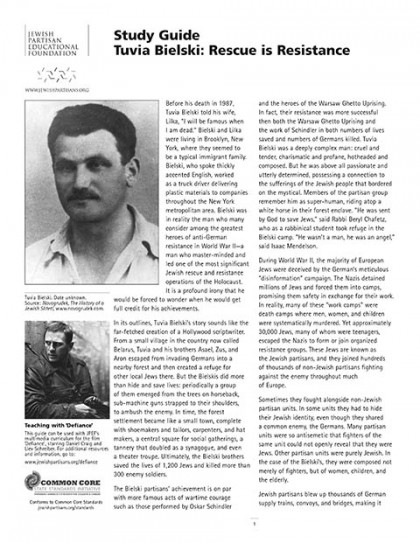
Tuvia Bielski: Rescue is Resistance
The Bielski brothers — Tuvia, Asael, Zus and Aron — rescued 1,200 Jews and formed one of the largest and most successful Jewish Partisan units, even building an entire village inside enemy territory. Written with Bielski biographer Peter Duffy. (For grades 7-12+)
No registration required to download during the month of May
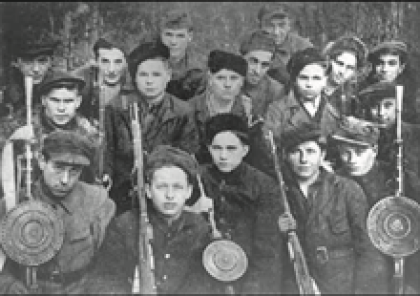
Who Are the Jewish Partisans?
Use this inspiring one-page study guide to teach about the 20,000 to 30,000 men and women — many of them teens — who fought back against the Nazis and their collaborators as Jewish partisans. Includes a survey of both armed and non-violent Jewish resistance during the Holocaust. (For grades 6-12+)
No registration required to download during the month of May
Lesson Plans & Activities
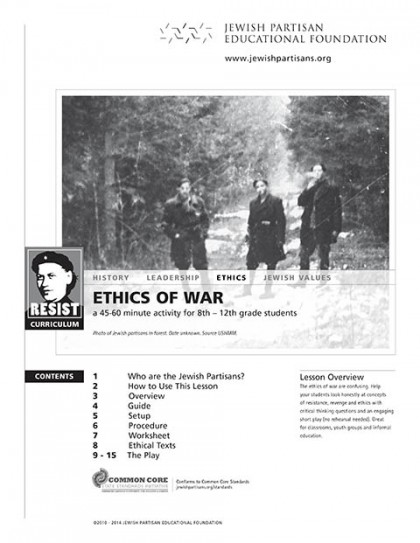
Ethics of War
The ethics of war are confusing. Help your students look honestly at concepts of resistance, revenge and ethics with critical thinking questions and an engaging short play (no rehearsal needed). Great for classrooms, youth groups and informal education. (For grades 8-12)
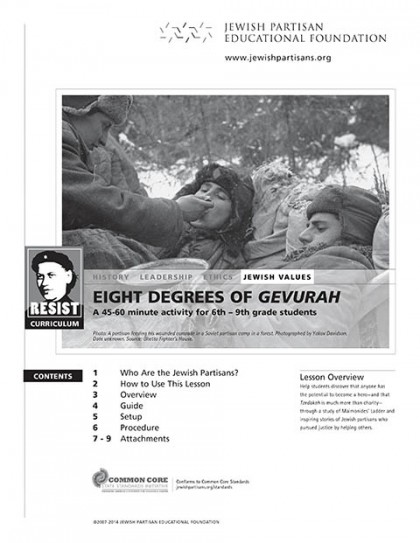
Eight Degrees of Gevurah
Help students discover that anyone has the potential to become a hero — and that Tzedakah is much more than charity — through a study of Maimonides' Ladder and inspiring stories of Jewish partisans who pursued justice by helping others. (For grades 6-9)
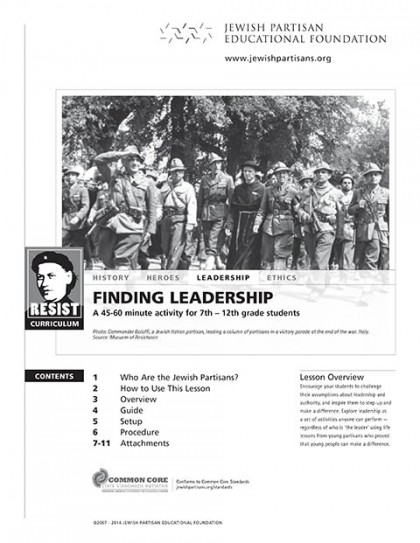
Finding Leadership
Encourage your students to challenge their assumptions about leadership and authority, and inspire them to step up and make a difference. Explore leadership as a set of activities anyone can perform — regardless of who is 'the leader' using life lessons from young partisans who proved that young people can make a difference. (For grades 8-12)
Warsaw Ghetto Uprising Study Guide
Download the study guide about the Warsaw Ghetto Uprising and watch the trailer for the film Uprising.
Survival in the Forest Study Guide
The Survival in the Forest Study Guide accompanies JPEF's 2014 film, Survival in the Forest: Isidore Karten and the Partisans. It examines the partisan history of Isidore and his brother Hersch who saved more than 400 Jews, aided by righteous gentiles. It explores human behavior during the Holocaust and what motivated people to risk their lives to save Jews. Classroom activities and discussion prompts serve as catalysts for students to explore their behaviors. What role will they play in the future when faced with the decision to take action in the face of injustice, antisemitism, and tyranny? Will they act or remain passive? Will they become Upstanders or be Bystanders?
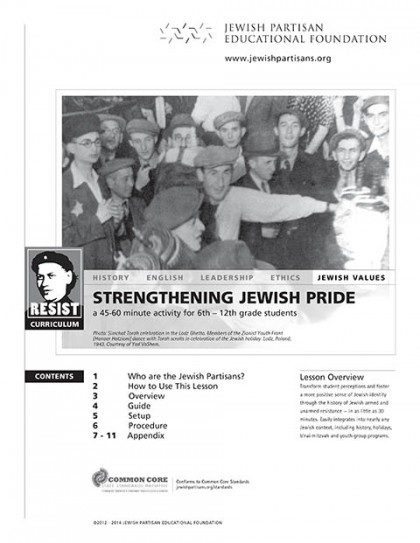
Strengthening Jewish Pride
Transform student perceptions and foster a more positive sense of Jewish identity through the history of Jewish armed and unarmed resistance — in as little as 30 minutes. Easily integrates into nearly any Jewish context, including history, holidays, b'nai mitzvah and youth group programs. (For grades 7-12)
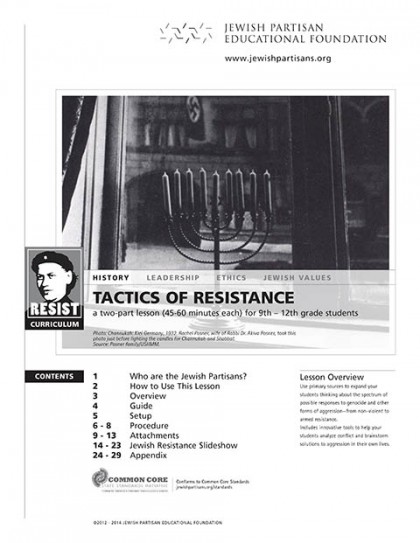
Tactics of Resistance
Expand your students' thinking about the spectrum of possible responses to genocide and other forms of aggression from non-violent to armed resistance. Includes the Resistance Matrix — a new tool to help your students analyze conflict and brainstorm solutions that you can use throughout the year — plus JPEF's Jewish Resistance Slideshow (see below). (For grades 9-12+)
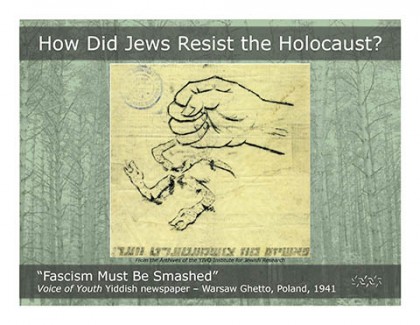
Jewish Resistance Slideshow
Rare, archival images of Jewish armed and non-violent resistance during the Holocaust. Can be used standalone or with other materials — particularly JPEF's Tactics of Resistance and Strengthening Jewish Pride lessons. (For grades 6-12+)
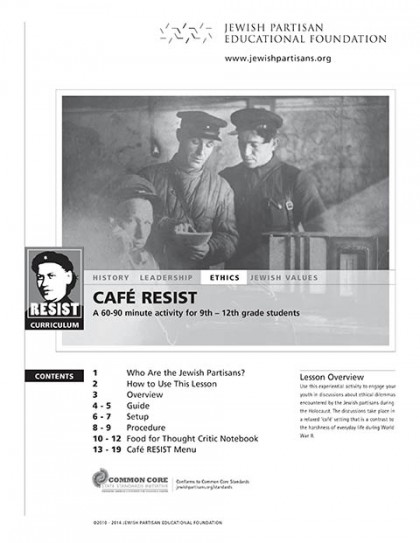
Café RESIST
Use this experiential activity to engage your youth in discussions about ethical dilemmas encountered by the Jewish partisans during the Holocaust. The discussions take place in a relaxed 'café' setting that is a contrast to the harshness of everyday life during World War II. (For grades 9-12)
Teaching with "Defiance"
Use the film "Defiance" — starring Daniel Craig and Liev Schreiber — to explore History, Leadership, Ethics, Jewish Values and Primary Sources. Inspire and engage your students with the true story of the Bielski brothers, who saved 1,200 lives and organized the largest Jewish resistance unit during World War II. (For grades 9-12+)
No registration required to download during the month of May
Study Guides
Who Are the Jewish Partisans?
Use this inspiring one-page study guide to teach about the 20,000 to 30,000 men and women — many of them teens — who fought back against the Nazis and their collaborators as Jewish partisans. Includes a survey of both armed and non-violent Jewish resistance during the Holocaust. (For grades 6-12+)
No registration required to download during the month of May
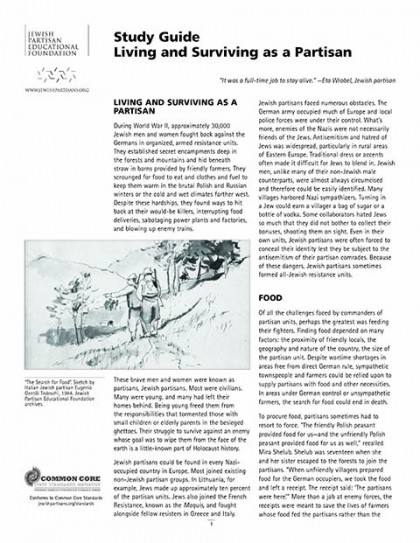
Living and Surviving in the Partisans
Answer your students' most frequently asked questions, including: How did the partisans survive in the forest? Where did they get their weapons and food? What happened if someone got sick? (For grades 6-12+)
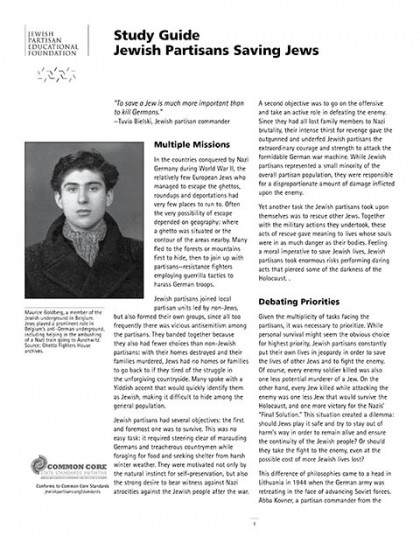
Jewish Partisans Saving Jews
Thousands of Jews were saved by Jewish partisans. From protecting and feeding Jews hiding in the forests, to digging tunnels under ghetto walls and smuggling prisoners out, Jewish partisans risked their lives to rescue others. (For grades 7-12+)
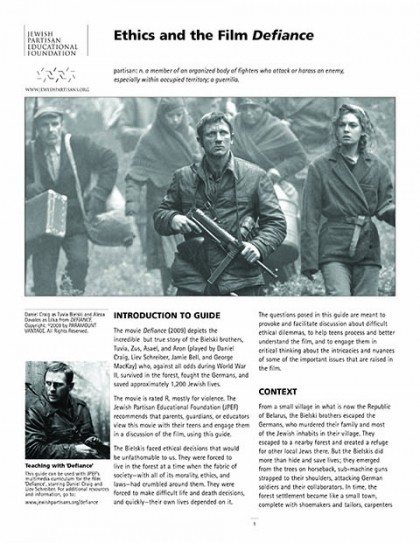
Ethics and the Film 'Defiance' Discussion Guide
Are there times when it is morally right to steal, to kill, even to take revenge? Should there be? Use the film Defiance — starring Daniel Craig and Liev Schreiber — to examine complex ethical issues with your teens. Includes Jewish ethical texts, plus interviews with screenwriter Clay Frohman. (For grades 9-12+)
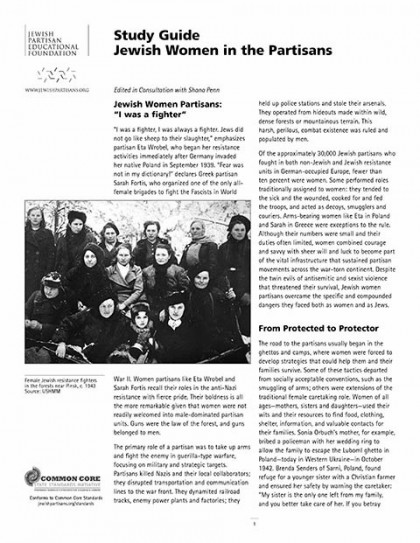
Jewish Women in the Partisans
Inspire your students with the history of Jewish women who overcame racism and sexism to join the fight against the Nazis as soldiers, commanders, couriers and spies, medics, and vital support personnel. (For grades 8-12+)
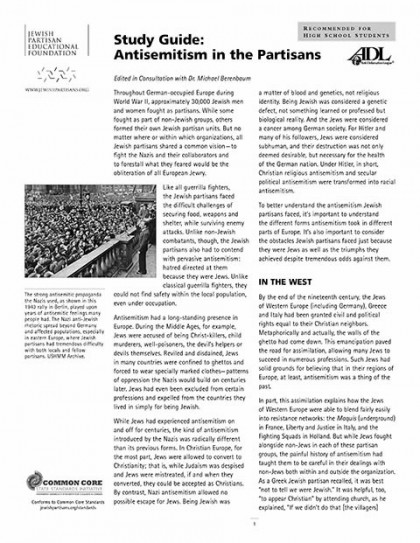
Antisemitism in the Partisans
Teach your students about the strategies Jewish partisans used to rescue fellow Jews and overcome murderous antisemitism in a war on three fronts. (For grades 9-12+)
Partisan Biographies
Tuvia Bielski: Rescue is Resistance
The Bielski brothers — Tuvia, Asael, Zus and Aron — rescued 1,200 Jews and formed one of the largest and most successful Jewish Partisan units, even building an entire village inside enemy territory. Written with Bielski biographer Peter Duffy. (For grades 7-12+)
No registration required to download during the month of May
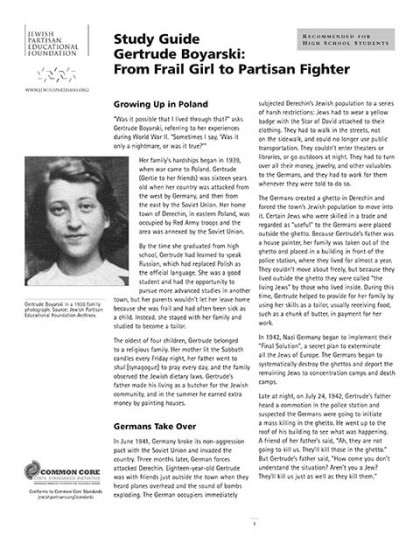
Gertrude Boyarski: From Frail Girl to Partisan Fighter
After Nazi collaborators killed her family, 18-year-old Gertrude convinced the commander of a Russian partisan camp to let her fight. With the help of a friend, she burned down an enemy bridge, earning one of the Soviet Union's highest honors. (For grades 7-12+)
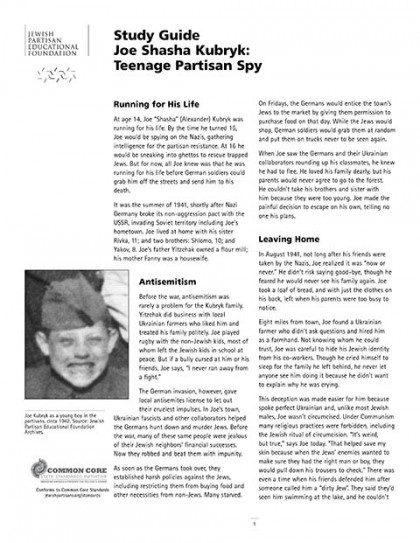
Joe Kubryk: Teenage Partisan Spy
At age 15, Joe Kubryk joined the junior secret service for a Russian partisan reconnaissance unit. Pretending to be a local beggar he gained vital intelligence from the Germans, and later snuck into the ghettos to help rescue over 100 Jews. (For grades 7-12+)
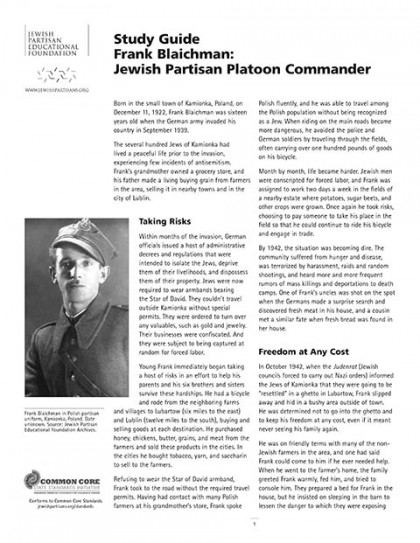
Frank Blaichman: Jewish Partisan Platoon Commander
At age 21, Frank was the youngest platoon commander in his all-Jewish unit of 400. Toward the end of the war, his unit escorted the future Prime Minister of Poland to a secret meeting with the Soviet high command. (For grades 7-12+)
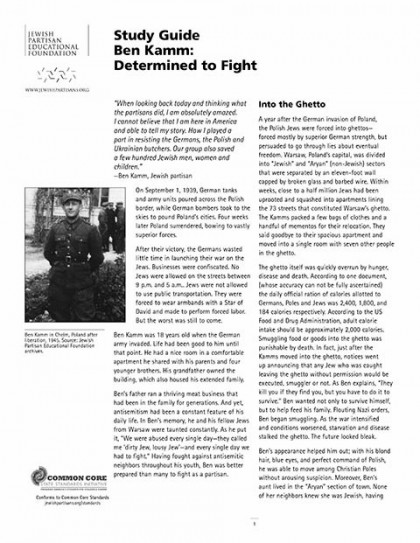
Ben Kamm: Determined to Fight
18-year-old Ben Kamm joined a Russian partisan group of more than 1,600 fighters led by General Fyodorov. He was trained to place mines under train tracks and disrupt enemy equipment flow. Ben also led an attack on the Janon Lubelski labor camp, freeing the 600 Jews held inside. (For grades 7-12+)
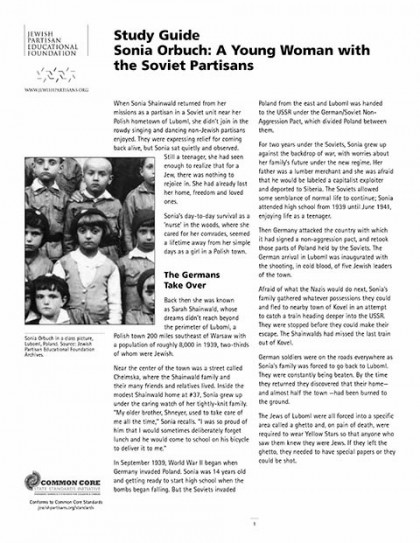
Sonia Orbuch: A Young Woman with the Soviet Partisans
Sonia escaped with her family at the age of 16 from the Nazi-occupied town of Luboml, Poland. After hiding in the freezing woods for months, Sonia served as a field nurse and hospital aide, using whatever makeshift supplies were available. (For grades 7-12+)
Additional Materials
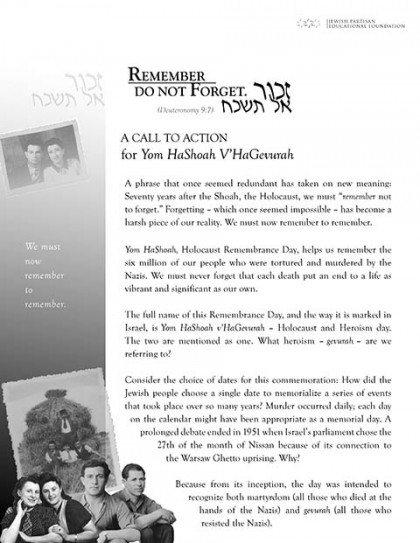
Putting the Gevurah Back in Yom HaShoah (2 pages)
Reader/liturgy supplement for communities wanting to acknowledge the intent of Holocaust Remembrance Day as it was started in Israel, in 1951. Includes a brief history and a prayer honoring the millions of armed and unarmed Jewish resistors. (For grades 7-12 and adults)
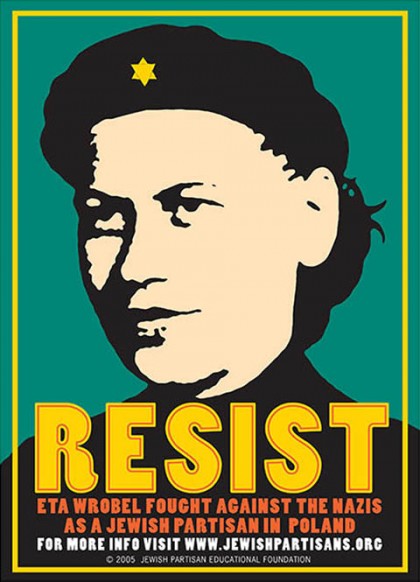
RESIST! Poster - Eta Wrobel (color)
Download and print a JPEF Resist poster featuring Jewish partisan Eta Wrobel. Two sizes, print in color or black and white.
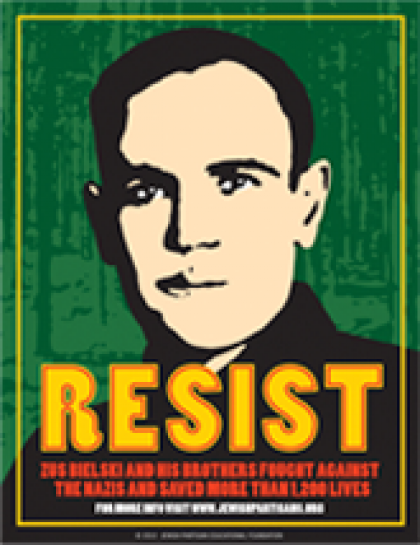
RESIST! Poster - Zus Bielski (color)
Download and print a JPEF Resist poster featuring partisan Zus Bielski.
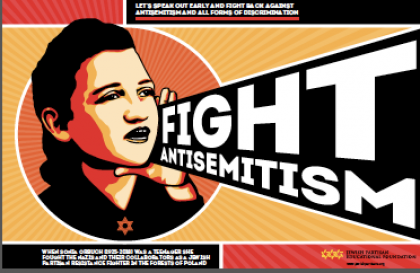
Sonia Orbuch - Fight Antisemitism
Download and print a JPEF poster featuring Jewish partisan Sonia Orbuch.